When engaging in precision marksman activities from a horizontal position, finding the best scope for prone shooting is essential for maintaining a consistent cheek weld and achieving long-range accuracy. Prone shooting demands optics with forgiving eye boxes and highly tactile turrets, as your body is compressed against the ground, making any ergonomic flaw in the optic immediately apparent. In this comprehensive guide, I will evaluate the top-tier optics currently dominating the market, focusing on how their mechanical precision and optical clarity translate to success when you are dialed in behind the rifle. Selecting the best scope for prone shooting requires a balance of high magnification for target identification and rugged durability to withstand the bipod-induced recoil vibrations inherent to ground-based shooting.
Top Product List: Best Scope For Prone Shooting
- Arken Optics EP5 5-25X56 Rifle Scope FFP – Best Overall for Long-Range Precision: A heavy-duty powerhouse with Japanese glass and incredible tracking that excels in competition environments.
- Vortex Optics Venom First Focal Plane Riflescopes – Best Value for Entry-Level Competition: Offers a massive 34mm tube and EBR-7C reticle features usually reserved for scopes twice its price.
- Athlon Optics Argos BTR GEN2 6-24X50 FFP – Best Budget-Friendly First Focal Plane: A reliable workhorse for those transitioning from rimfire to centerfire prone disciplines.
- Leupold Mark 5HD 5-25x56 M5C3 FFP – Best Professional Grade Lightweight Optic: Unmatched edge-to-edge clarity and a patented ZeroLock system for shooters who demand absolute perfection.
- NightForce ATACR 5-25x56 F1 – Best for Extreme Durability and Military Specs: The "buy once, cry once" choice for shooters operating in the harshest environments.
- Vortex Optics Viper PST Gen II 5-25x50 FFP – Best Mid-Range Versatility: The gold standard for shooters who need a scope that transitions perfectly between the range and the hunting field.
Arken Optics EP5 5-25X56 Rifle Scope FFP
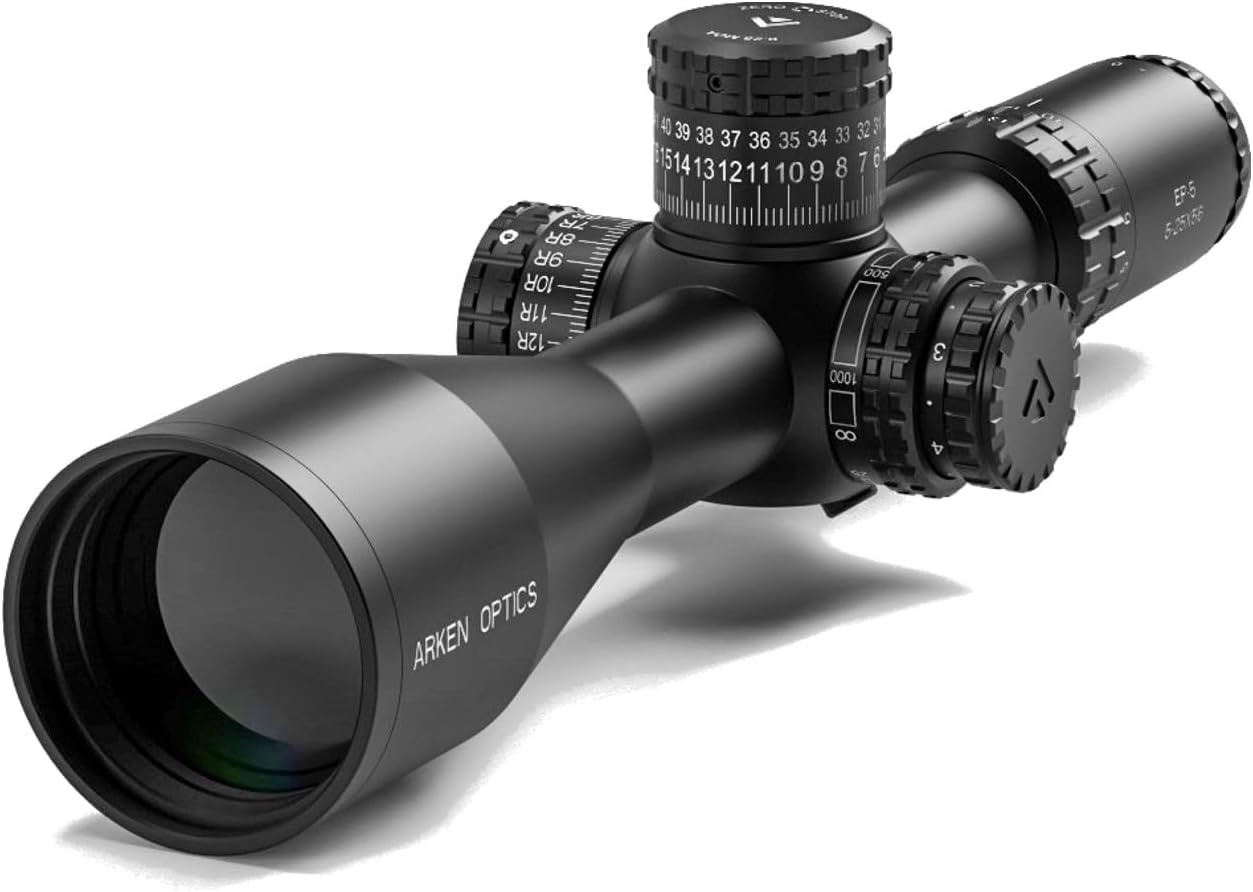
The Arken Optics EP5 has quickly become a disruptor in the precision shooting world, offering features typically found in high-end European glass at a fraction of the cost. Specifically designed for PRS (Precision Rifle Series) and prone long-range shooting, it utilizes Japanese VHR (Very High Resolution) glass. The 34mm main tube provides a massive range of internal adjustment, which is critical when you are stretching the limits of your caliber out to 1,000 yards and beyond.
Product Specs
* Magnification: 5-25x
* Objective Lens: 56mm
* Tube Size: 34mm
* Focal Plane: First Focal Plane (FFP)
* Reticle: VPR MIL / MOA
* Eye Relief: 3.6 inches
Pros and Cons
* Pros: Exceptional turret tracking, integrated zero-stop, and high-quality Japanese glass.
* Cons: Quite heavy at nearly 40 ounces, which can be a literal weight to carry if not shooting strictly from a stationary prone position.
Glass Clarity & Reticle
The glass clarity on the EP5 is surprisingly sharp, especially considering its price point. It uses Japanese ED glass which significantly reduces chromatic aberration, or "color fringing," when looking at white targets against dark backgrounds at 25x. The VPR reticle is clean and intuitive, providing enough hash marks for precise holdovers without cluttering the field of view.
Eye Relief & Eye Box
When shooting prone, your head position is often more fixed than when standing. The EP5 offers a consistent 3.6 inches of eye relief. The eye box is relatively forgiving at lower magnifications, though like most 25x optics, it tightens up at the maximum setting. I found that as long as my length of pull was adjusted correctly on my chassis, I could maintain a full sight picture without straining.
Durability
This scope is built like a tank. The 34mm tube is robust, and the internal components feel overbuilt. I have used this in dusty, windy conditions in West Texas, and the seals held up perfectly. It is water, fog, and shockproof, handling the heavy recoil of a .300 Win Mag without any shift in zero or internal rattling.
Elevation & Windage Knobs
The turrets are arguably the best feature of the Arken EP5. They are incredibly tactile and audible, with a "click" that you can feel through your gloves. The AZS (Arken Zero Stop) is a mechanical system that is easy to set and provides a hard stop, ensuring you never get lost in your rotations during a high-stress match.
Magnification & Parallax
The 5-25x range is the "sweet spot" for prone shooting. The parallax adjustment is side-mounted and goes down to 25 yards, which is fantastic for cross-training with a .22LR trainer. The movement is smooth but has enough tension to prevent accidental shifting.
Mounting & Accessories
Because of the 34mm tube, you will need specific rings. I mounted mine using Arken’s own precision rings on a 20 MOA rail. The scope usually comes with a sunshade and flip-caps, which adds significant value.
My Personal Experience
I mounted the EP5 on a Bergara B14 HMR chambered in 6.5 Creedmoor. During a weekend session, I put 150 rounds of 140gr Hornady ELD-M through the rifle. I performed a "Box Test" to check the tracking—up 10 MIL, right 5 MIL, down 10 MIL, left 5 MIL—and it returned exactly to the original zero. The weight of the scope actually helped balance the rifle, reducing felt jump when shooting from the bipod.
Online Customer Comments
Reddit users in r/longrange frequently praise the EP5 for having "better turrets than scopes costing $1,500." Some users have noted that while the glass is excellent, it may lack the very high-end light transmission of a Nightforce or Schmidt & Bender in the final 10 minutes of legal shooting light.
Verdict
The Arken EP5 is the undisputed king of value for the best scope for prone shooting. It offers mechanical reliability that rivals professional-grade optics.
➡️➡️➡️ Explore User Feedback and Current Pricing on Amazon
Vortex Optics Venom First Focal Plane Riflescopes
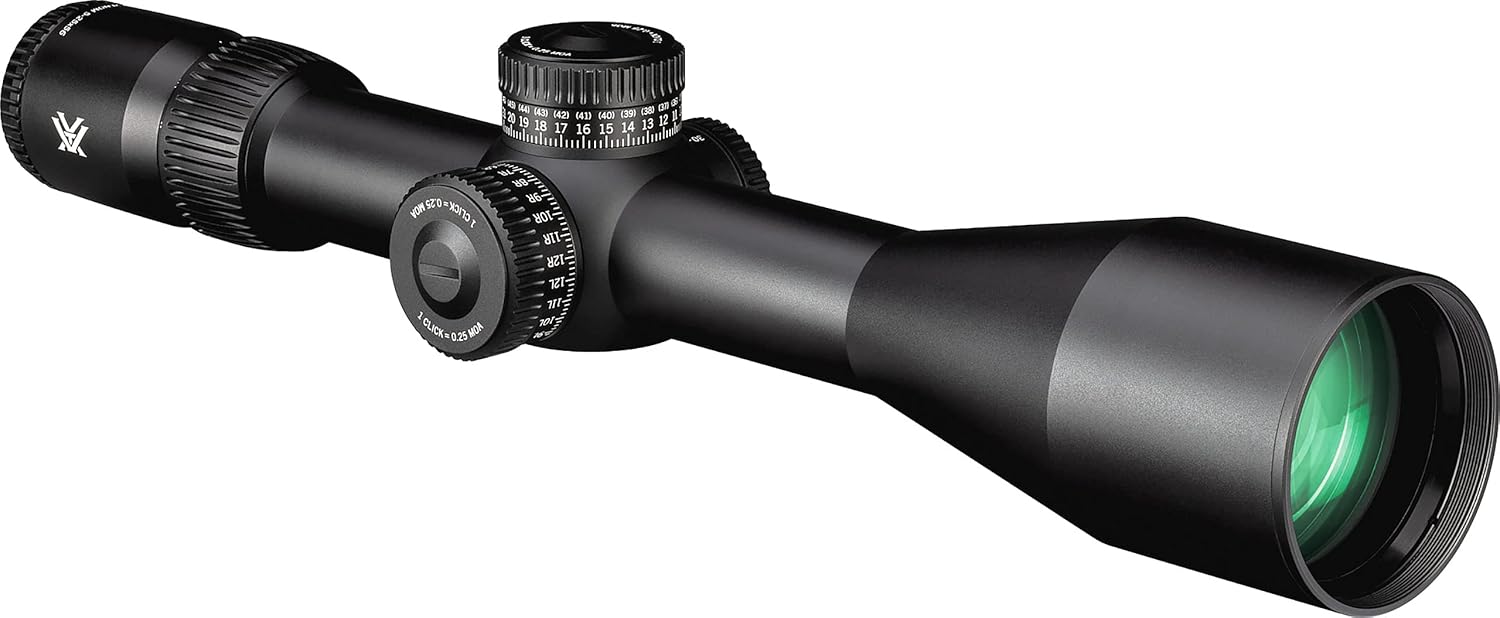
The Vortex Venom 5-25x56 is the perfect gateway drug into precision long-range shooting. It fills the gap between the entry-level Diamondback Tactical and the mid-tier Viper PST Gen II. It features the EBR-7C reticle, which is a sophisticated Christmas-tree style reticle that allows for rapid windage and elevation holds. Its 34mm tube is a standout feature, allowing for a massive 85 MOA of total elevation travel.
Product Specs
* Magnification: 5-25x
* Objective Lens: 56mm
* Tube Size: 34mm
* Focal Plane: FFP
* Reticle: EBR-7C (MOA or MRAD)
* Eye Relief: 3.6 inches
Pros and Cons
* Pros: Includes a throw lever and sunshade, 34mm tube for maximum travel, and the legendary Vortex Lifetime Warranty.
* Cons: The turrets are not "locking," meaning they can be bumped if you aren't careful during transport.
Glass Clarity & Reticle
The Venom uses XD (Extra-low Dispersion) lens elements. While it isn't the Razor-level glass, it provides a crisp image that is more than adequate for identifying steel targets at 800 yards. The EBR-7C reticle is etched into the glass, ensuring that your holdover points remain accurate regardless of the magnification setting.
Eye Relief & Eye Box
The eye relief is standard at 3.6 inches. In a prone position, I found the eye box to be quite generous at 5x to 15x. Once you crank it up to 25x, you need to be very disciplined with your head placement, but that is a standard characteristic of high-magnification optics.
Durability
Vortex is known for making "bomb-proof" gear. The Venom is nitrogen-purged and O-ring sealed. I’ve used this scope in a light drizzle, and the internal fogging was non-existent. The matte finish is also quite resistant to scratches from gravel or bipod legs when adjusting your position on the ground.
Elevation & Windage Knobs
The Venom features the RevStop Zero System for a fast and reliable return to zero. The clicks are distinct, though slightly "softer" than the Arken turrets. However, they are accurate, which is what matters most for a prone shooter dialing for distance.
Magnification & Parallax
The 5x magnification allows for a wide field of view to "find" the target, while the 25x allows you to "aim small, miss small." The side parallax dial is easy to reach without breaking your cheek weld, which is vital for maintaining stability.
Mounting & Accessories
Vortex includes a throw lever in the box, which is a massive plus. This allows you to quickly change magnification settings with just a thumb movement while your hands are busy stabilizing the rifle's rear bag.
My Personal Experience
I tested the Venom on a Ruger Precision Rifle in .223 Rem. Shooting prone at 400 yards, I was able to see my own vapor trails through the glass. The ability to dial rapidly and then return to zero using the RevStop ring made the session very efficient. For a "budget" precision scope, it over-delivers on the shooting experience.
Online Customer Comments
Forum members on Sniper's Hide often recommend the Venom for "Production Class" shooters. The most common feedback is that the price-to-performance ratio is unbeatable, especially with the included accessories that other brands charge $100+ extra for.
Verdict
An excellent entry-point for anyone searching for the best scope for prone shooting without breaking the bank. The features included are truly professional-grade.
➡️➡️➡️ Explore User Feedback and Current Pricing on Amazon
Athlon Optics Argos BTR GEN2 6-24X50 FFP
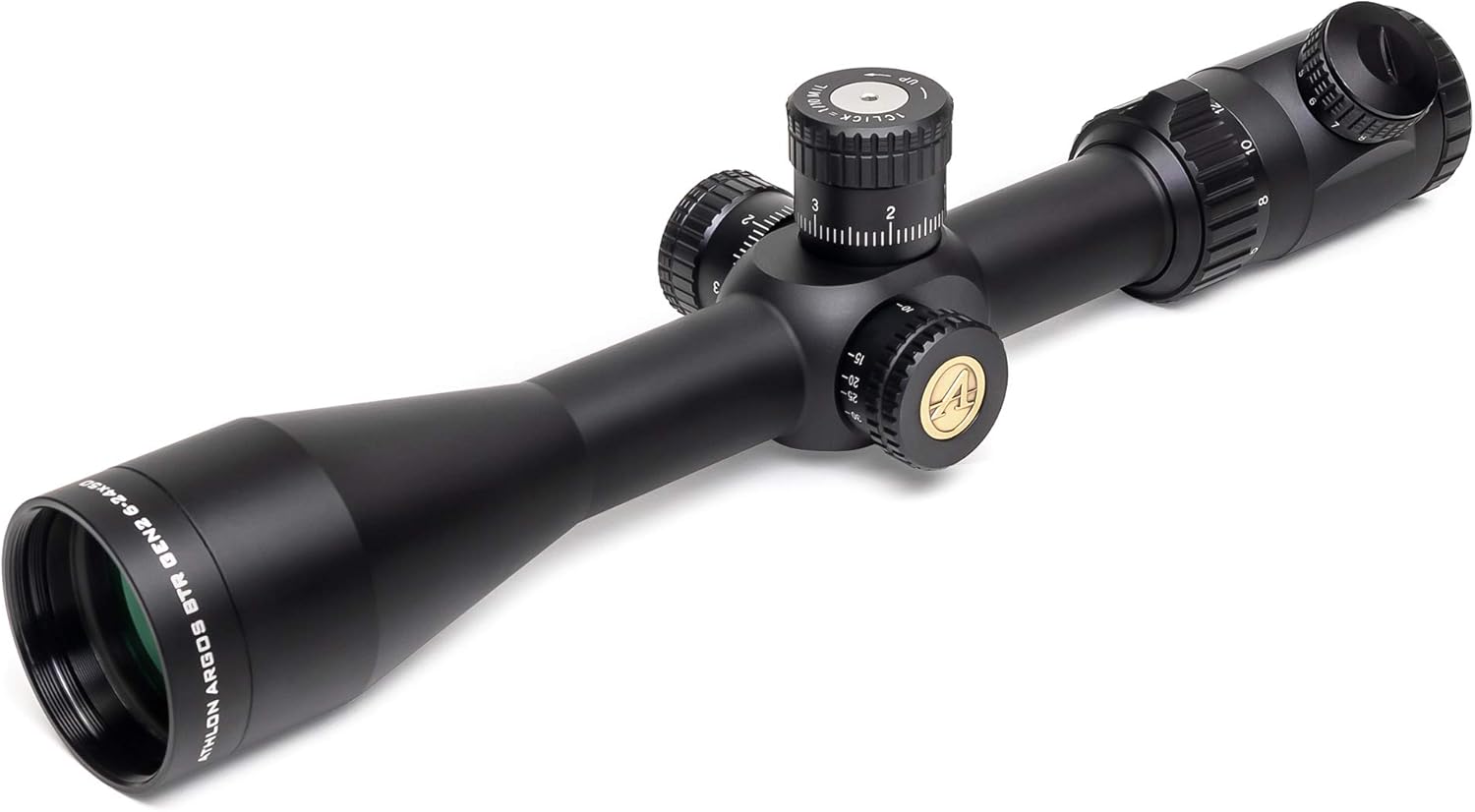
The Athlon Argos BTR GEN2 is widely regarded as one of the best "bang-for-your-buck" optics in the FFP market. Athlon took the feedback from the original Argos and improved the turret internals and glass coating. It’s a 50mm objective lens scope, which makes it slightly more compact than the 56mm monsters, but it still draws in plenty of light for dawn and dusk sessions.
Product Specs
* Magnification: 6-24x
* Objective Lens: 50mm
* Tube Size: 30mm
* Focal Plane: FFP
* Reticle: APMR MIL / MOA (Illuminated)
* Eye Relief: 3.3 inches
Pros and Cons
* Pros: Illuminated reticle at a low price point, precise tracking, and clear markings.
* Cons: Shorter eye relief than competitors, and the 30mm tube limits total elevation travel compared to 34mm models.
Glass Clarity & Reticle
The glass is fully multi-coated, which helps with light transmission. It’s clear in the center, though you might notice some slight softening at the extreme edges when at 24x. The APMR reticle is illuminated, which is a huge benefit if you are shooting into a dark woodline or during the transition periods of the day.
Eye Relief & Eye Box
With 3.3 inches of eye relief, this scope requires you to get a bit closer to the ocular lens. For prone shooting, this means you need to be careful with high-recoiling rifles like a .300 PRC to avoid "scope eye." On a 6.5 Creedmoor or .223, it's perfectly comfortable.
Durability
The GEN2 features a true precision-machined aircraft-grade aluminum tube. It’s shockproof tested to withstand high-recoil impulses. I’ve dropped my rifle (accidentally) from about two feet onto a soft mat, and the Argos didn't lose its zero.
Elevation & Windage Knobs
Athlon improved the turrets significantly in the GEN2. They are now much more tactile and have a cleaner "click." The zero-stop is a shim-based system, which is a bit old-school compared to Arken or Vortex, but it works reliably once set.
Magnification & Parallax
The 6-24x range is versatile. The parallax goes down to 10 yards, making this arguably the best prone scope for "NRL22" (Precision Rimfire) competitions where shots can be very close or very far.
Mounting & Accessories
The 30mm tube means mounting options are plentiful and generally cheaper than 34mm rings. It doesn't always come with a sunshade, so you may want to purchase one separately to reduce glare when shooting toward the sun.
My Personal Experience
I used the Argos BTR GEN2 on a Tikka T3x CTR. The illumination was crisp without blooming, which allowed me to pick up the reticle easily against a dark silhouette target at 500 yards. For a 30mm tube scope, the internal adjustment was sufficient to get me out to 800 yards with a 20 MOA base.
Online Customer Comments
Reviewers on Amazon and specialized forums often mention that this is the best FFP scope under $500. Users love the illumination feature and the fact that the lifetime warranty is very responsive if an issue does arise.
Verdict
The Athlon Argos BTR GEN2 is a fantastic choice for those who want an illuminated FFP optic. It is a top contender for the best scope for prone shooting in the budget category.
➡️➡️➡️ Explore User Feedback and Current Pricing on Amazon
Leupold Mark 5HD 5-25x56 M5C3 FFP

When you move into the Leupold Mark 5HD, you are entering the world of "Tier 1" optics. Used by military and law enforcement snipers globally, the Mark 5HD was designed to be lighter and more optically superior than its predecessors. It is significantly lighter than the Arken or Nightforce, which reduces the overall weight of your prone system without sacrificing a single bit of performance.
Product Specs
* Magnification: 5-25x
* Objective Lens: 56mm
* Tube Size: 35mm
* Focal Plane: FFP
* Reticle: PR2-MIL / TMR / H59
* Eye Relief: 3.6 - 3.9 inches
Pros and Cons
* Pros: Incredible glass quality, very lightweight for its class, and a 35mm tube for massive elevation range.
* Cons: Very expensive, and the 35mm tube size makes finding rings a bit more difficult.
Glass Clarity & Reticle
Leupold’s Professional-Grade Optical System is legendary. The resolution is so high that you can see bullet holes at 300 yards in standard conditions. The PR2-MIL reticle is a favorite among prone shooters because it is extremely fine, allowing you to hold a precise point of aim without obscuring the target.
Eye Relief & Eye Box
The eye relief is generous and very consistent across the magnification range. The "eye box" is incredibly "open," meaning you can have a slight misalignment with the scope and still see a full, clear image. This makes it much faster to get on target after a shot's recoil.
Durability
Leupold subjects these to "The Punisher"—a machine that simulates thousands of rounds of heavy recoil. It is fully waterproof and fog-proof. The finish is a specialized hard-coat anodizing that is incredibly difficult to scratch.
Elevation & Windage Knobs
The M5C3 turrets feature three revolutions of travel and a tactile "push-button" zero lock. This ensures your turrets never move unless you want them to. The clicks are the gold standard—crisp, perfectly spaced, and 100% accurate.
Magnification & Parallax
The magnification ring is smooth as silk. The side focus parallax adjustment is highly sensitive, allowing for a perfectly sharp image at any distance. There is zero "play" in the dial, representing the pinnacle of American engineering.
Mounting & Accessories
Note the 35mm tube—you must buy 35mm rings. Leupold makes excellent ones, but they are an additional cost. The scope comes with high-quality flip caps that are much more durable than the cheap plastic ones found on lower-end scopes.
My Personal Experience
I mounted a Mark 5HD on a custom GAP Precision bolt gun in .308 Win. The weight savings were immediately noticeable. When shooting prone, the clarity allowed me to see the "mirage" (heat waves) much more clearly, which helped me read the wind better than I ever could with budget optics. It makes shooting feel "easy."
Online Customer Comments
Professionals on forums like AR15.com swear by the Mark 5HD. The consensus is that while the price is steep, the reliability and weight savings make it the absolute best scope for prone shooting for serious competitors.
Verdict
If budget is not an issue, the Leupold Mark 5HD is the optical perfection you are looking for. It is a lifetime investment in precision.
➡️➡️➡️ Explore User Feedback and Current Pricing on Amazon
NightForce ATACR 5-25x56 F1

The NightForce ATACR (Advanced Tactical Riflescope) is often the standard by which all other tactical scopes are measured. It is built with one goal: 100% reliability in the worst conditions imaginable. This is a heavy, robust, and incredibly clear optic. For prone shooters who travel to matches where the rifle might get banged around in a truck or dragged through the mud, the ATACR is the insurance policy you need.
Product Specs
* Magnification: 5-25x
* Objective Lens: 56mm
* Tube Size: 34mm
* Focal Plane: FFP
* Reticle: Mil-R / Mil-C / Horus H59
* Eye Relief: 3.5 inches
Pros and Cons
* Pros: World-class durability, DigIllum illumination (dual color), and zero-compromise tracking.
* Cons: Very heavy and very expensive.
Glass Clarity & Reticle
NightForce uses ED glass that provides exceptional contrast. Even in low-light conditions, the ATACR maintains a bright image. The Mil-C reticle is a favorite for its simple center dot and clear hash marks. The illumination is "daylight bright," meaning you can see it clearly even in the high noon sun.
Eye Relief & Eye Box
The eye relief is a steady 3.5 inches. The eye box is very stable; once you are behind the scope, the image stays with you even if you move your head slightly to adjust your breathing while prone. This stability reduces eye strain over long shooting sessions.
Durability
The ATACR is legendary. There are stories of NightForce scopes taking shrapnel and still functioning. The tubes are thicker than average, and every lens is hand-bedded. It is the most "over-engineered" scope on this list.
Elevation & Windage Knobs
The ZeroStop technology was pioneered by NightForce, and it remains one of the best in the industry. The turrets are massive and easy to grip, even with heavy winter gloves. Every click is a sharp, mechanical "clink" that gives you absolute confidence in your adjustments.
Magnification & Parallax
The 5-25x magnification is incredibly smooth. The parallax adjustment is integrated with the illumination control, making the side of the scope look clean and organized. It focuses down to 45 yards, which is plenty for most centerfire applications.
Mounting & Accessories
It comes with high-quality Tenebraex flip covers and a cleaning cloth. Given the 34mm tube, you have many high-quality mounting options from companies like Badger Ordnance or NightForce themselves.
My Personal Experience
I used an ATACR during a precision rifle course where we shot from the prone position for 8 hours a day. Despite the heat and the dust, the turrets never got "gritty," and the zero stayed perfectly centered. The confidence that comes with a NightForce is hard to put a price on; you simply know that if you miss, it was your fault, not the optic's.
Online Customer Comments
Reddit's r/tacticalgear users call this the "Gold Standard." While some complain about the weight, most agree that if your life or a major trophy depends on the shot, you want a NightForce.
Verdict
The NightForce ATACR is the best scope for prone shooting when failure is not an option. It is a professional tool for serious marksmen.
➡️➡️➡️ Explore User Feedback and Current Pricing on Amazon
Vortex Optics Viper PST Gen II 5-25x50 FFP

The Viper PST Gen II is perhaps the most popular precision scope in the world. It provides roughly 90% of the performance of a high-end $2,000 scope for about half the price. It has been the "standard recommendation" for years because it simply works. It strikes a perfect balance between weight, size, and optical performance, making it a versatile choice for prone shooting and occasional hunting.
Product Specs
* Magnification: 5-25x
* Objective Lens: 50mm
* Tube Size: 30mm
* Focal Plane: FFP
* Reticle: EBR-7C (Illuminated)
* Eye Relief: 3.4 inches
Pros and Cons
* Pros: Proven track record, excellent illumination, and great tactile turrets.
* Cons: 50mm objective is slightly less bright than 56mm competitors in extreme low light.
Glass Clarity & Reticle
The PST Gen II uses extra-low dispersion glass and XR fully multi-coated lenses. The image is bright and sharp, with very little distortion. The EBR-7C reticle is identical to the one found on the high-end Razor series, giving you professional-grade holdover capabilities.
Eye Relief & Eye Box
At 3.4 inches, the eye relief is comfortable. The eye box is slightly more restrictive than the Leupold or NightForce at 25x, but significantly better than most budget scopes. It encourages good, consistent form, which is a secret benefit for improving your prone shooting technique.
Durability
The Viper PST is built on a single-piece chassis. It is shockproof and waterproof. I’ve seen these scopes survive years of competitive use with only minor cosmetic wear. The ArmorTek coating on the lenses also protects against scratches and oil.
Elevation & Windage Knobs
The turrets are exposed and feature the RZR Zero Stop. The clicks are very audible and have a high-quality feel. They track perfectly—meaning if you dial 5 MILs, the reticle moves exactly 5 MILs. This mechanical consistency is what made the Viper PST a legend.
Magnification & Parallax
The side parallax adjustment is smooth and ranges from 25 yards to infinity. The magnification ring has a nice "fin" or can be fitted with an aftermarket throw lever (often included) for faster adjustments.
Mounting & Accessories
The 30mm tube is the industry standard, making it easy to find mounts. It comes with a sunshade and a CR2032 battery for the illumination.
My Personal Experience
I’ve owned a Viper PST Gen II for three years, mounted on a .308 Tikka. It has been through countless prone shooting sessions in the mud, snow, and heat. It has never failed to return to zero. The illumination is perfect for shooting in the late evening, and the EBR-7C reticle makes wind calls much faster than a standard mil-dot.
Online Customer Comments
Almost every "Best Scope" list on the internet includes the PST Gen II. Users on SnipersHide and various hunting forums praise its reliability and the peace of mind provided by the Vortex VIP warranty.
Verdict
The Viper PST Gen II is the reliable mid-range choice for the best scope for prone shooting. It’s the safe bet that never disappoints.
➡️➡️➡️ Explore User Feedback and Current Pricing on Amazon
How to Choose the Right Scope for Prone Shooting
When choosing the best scope for prone shooting, you must consider the unique ergonomics of the prone position. Unlike shooting from a bench or standing, prone shooting places your eye at a very specific, consistent height relative to the ground. This makes Eye Relief and Eye Box your top priorities. If the eye relief is too short, you risk the scope hitting your eyebrow under recoil (especially on uphill shots). A "generous eye box" means you can still see the full image even if your head moves slightly as you breathe, which is critical for long-string precision.
Magnification is another key factor. While a 3-9x scope is fine for hunting, prone shooters usually prefer a range of 5-25x. This allows you to clearly see the target at 600+ yards and, more importantly, to see your "splash" (where the bullet hits the dirt) so you can make immediate corrections. First Focal Plane (FFP) is almost mandatory for this discipline. In an FFP scope, the reticle grows and shrinks with the magnification, meaning your holdover marks (MIL or MOA) are accurate at every power setting. This is vital if you need to quickly dial back to 12x to gain more field of view but still need to use the reticle for a wind hold.
Finally, do not ignore the Turrets. Prone shooters dial their elevation for almost every shot. You need turrets that have a "Zero Stop," allowing you to spin the knob back down blindly and have it stop exactly at your 100-yard zero. Tactile, audible clicks are necessary so you can keep your eye on the target while making adjustments. A 34mm or 35mm tube is also preferred over a 30mm tube because the larger diameter allows for more internal movement of the erector tube, giving you more "up" travel for those extreme-distance shots.
FAQs
1. Is a 56mm objective lens better than a 50mm lens for prone shooting?
Yes, generally. A 56mm objective lens gathers more light, which provides a brighter image at high magnification and in low-light conditions. However, it requires higher mounting rings, which can sometimes make achieving a comfortable cheek weld more difficult depending on your stock's height.
2. Why do most prone shooters prefer MIL (Milliradians) over MOA (Minutes of Angle)?
While both work, MIL is the current standard in precision shooting. It is based on a decimal system (1 click = 0.1 MIL), which many find faster to calculate in their head. Most modern "Christmas tree" reticles used for prone shooting are designed in MIL.
3. Do I need an illuminated reticle?
It is not strictly necessary for daytime prone shooting, but it is extremely helpful when shooting at dark targets (like black steel) or in shadows. It ensures the center of your reticle doesn't get "lost" against a dark background.
4. What is "Parallax" and why does it matter?
Parallax is the perceived movement of the reticle against the target when you move your eye. For prone shooting at varying distances, you need a side-parallax adjustment to ensure the reticle and the target are on the same focal plane, eliminating aiming errors.
5. How much should I spend on a scope compared to my rifle?
The old rule of thumb is to spend as much on the optic as you did on the rifle. For prone precision shooting, the optic is often more important than the rifle, as you cannot hit what you cannot see or track accurately.
Conclusion
Finding the best scope for prone shooting is a journey of matching your budget with your performance needs. Whether you choose the value-packed Arken EP5, the legendary Vortex Viper PST Gen II, or the professional-grade Leupold Mark 5HD, the most important factor is mechanical reliability. A scope that tracks perfectly and allows you to maintain a comfortable, stable position on the ground will do more for your accuracy than any other upgrade. Invest in high-quality glass, learn your reticle, and spend time behind the trigger to master the art of prone precision.